
Finding Seek…
KEYWORDS: Ecology Education, Environmental Stewardship, Artificial Intelligence in Education (AIED), Enskillment, Instructional Design, Internet and Communications Technology (ICT), Machine Learning
Can Internet and Communications Technologies (ICT) and Artificial Intelligence (AI) truly support science learning…without dumbing down the learning opportunities?
This is a mission critical question for all of those who design learning pathways in science and ecology. Using technology tools can be a key part of trying hands-on science practices. But recent research has illuminated an important challenge…depending on AI tools too much weakens the neurological basis of skill development (Kosmyna et al, 2025). Without trying out the skills ourselves, we don’t grow the neural connections that support our own deep learning.
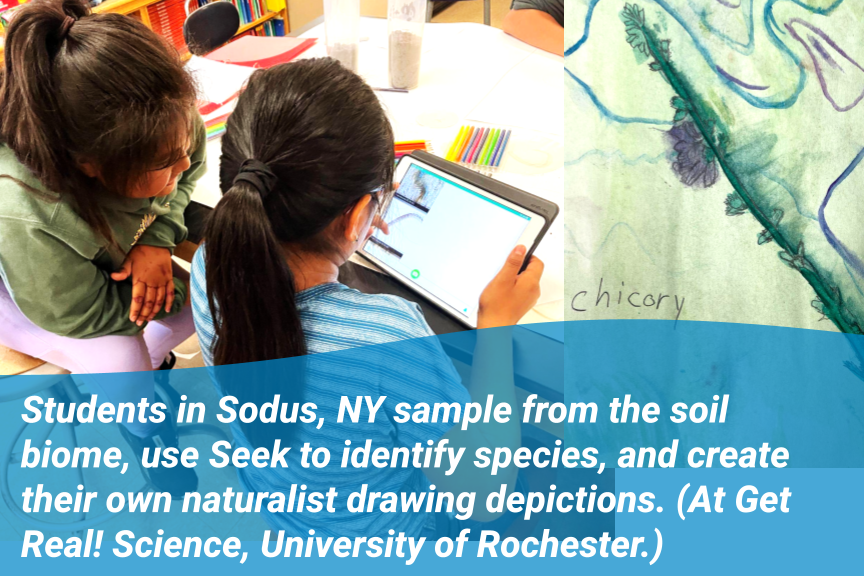
Students in Sodus, NY sample from the soil biome, use Seek to identify species, and create their own naturalist drawing depictions. With Get Real! Science, University of Rochester.
As an ecology teacher, I have a favorite AI tool I love to teach with: Seek. It’s an impressive app that compares images of nature with a large database to identify a species. Moreover, the app works with iNaturalist community, helping citizen scientists to develop their studies of local ecology questions.
How does one species depend on many others to live–what are the environmental factors that help a species to thrive? Which species are native, and co-evolved here together? And which species are invasive, compelling local ecologists to manage and control their spread? I’ve worked with diverse students in many settings to collect and identify species in the environment, conducting activities around these questions.
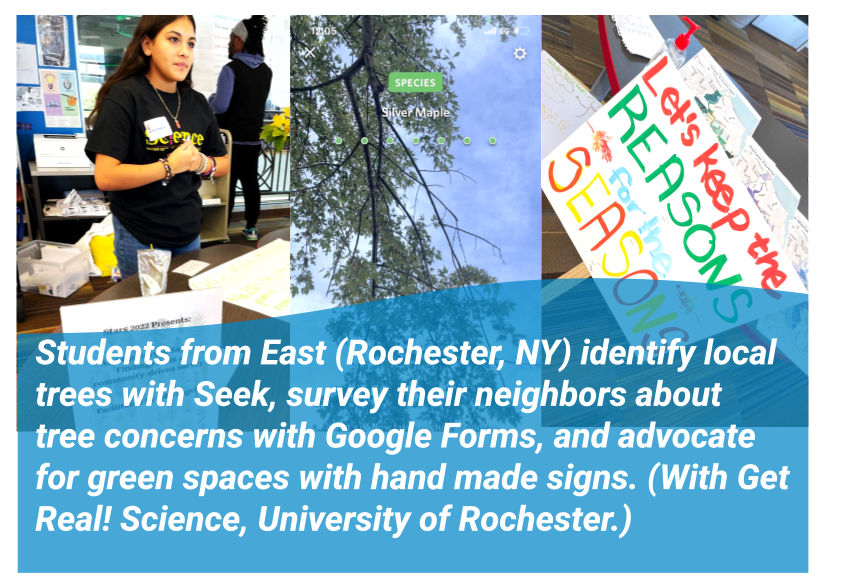
Students from East (Rochester, NY) identify local trees with Seek, survey their neighbors about tree concerns with Google Forms, and advocate for green spaces with hand made signs. (With Get Real! Science, University of Rochester.)
The Seek app helps youth to see species cladistics (the relationships between organisms)…but I’ve learned that it takes ongoing dialogue and model-based inquiry to answer more complex questions about ecology.
I first experimented with Seek with the amazing learning scientist Professor April Luehmann, and her circle of colleagues and students at Get Real! Science. We worked together in a science education “laboratory” – doing research with youth in parks and on shorelines, and collaborating with many local science leaders.
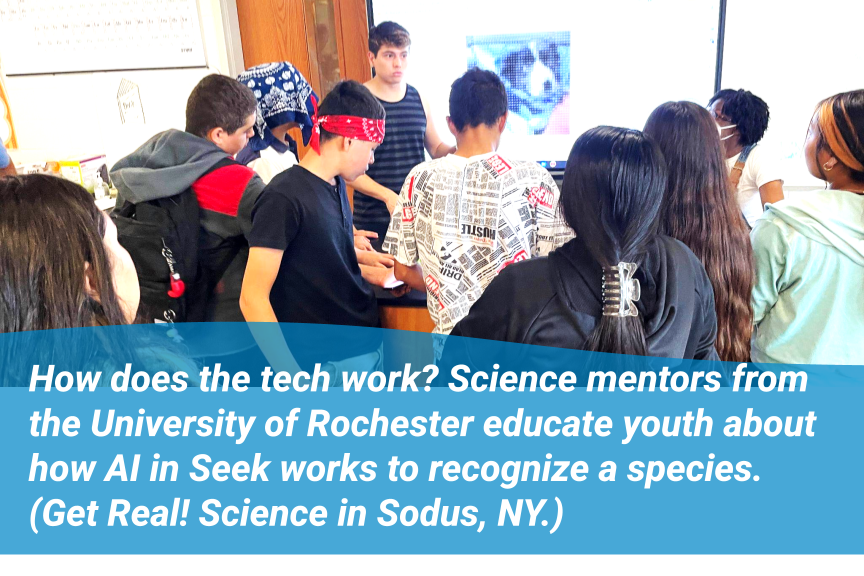
How does the tech work? Science mentors from the University of Rochester educate youth about how AI in Seek works to recognize a species. (Get Real! Science in Sodus, NY.)
Our youth teams and teachers engaged in hands-on, playful, and place-based science experiences. Moreover, youth connected with local experts, including farmers, public health researchers, ecologists, and urban planners. These mentors inspired youth to design their own studies and to take a stance, educating others about environmental stewardship. Beginning with Seek and species knowledge, youth learned more about topics like protecting fish from plastics pollution and improving respiratory health by planting urban trees. Deep diving into ecology with Seek can help us to think in new ways…and to learn to walk lightly on public lands.
Inspired by these experiences, we helped to design new, engaging way to introduce youth to ecology topics with Seek, combining species ID with the hands-on skills of Naturalist Drawing. Working with learners in Migrant Education Services summer programs in New York and the Burchfield Nature and Art Center, we experimented with a process for teaching the visual skills of studying species samples. Youth carefully draw and paint the samples while attending to the species phenotype. How many leaves does the branch have? How are they organized?
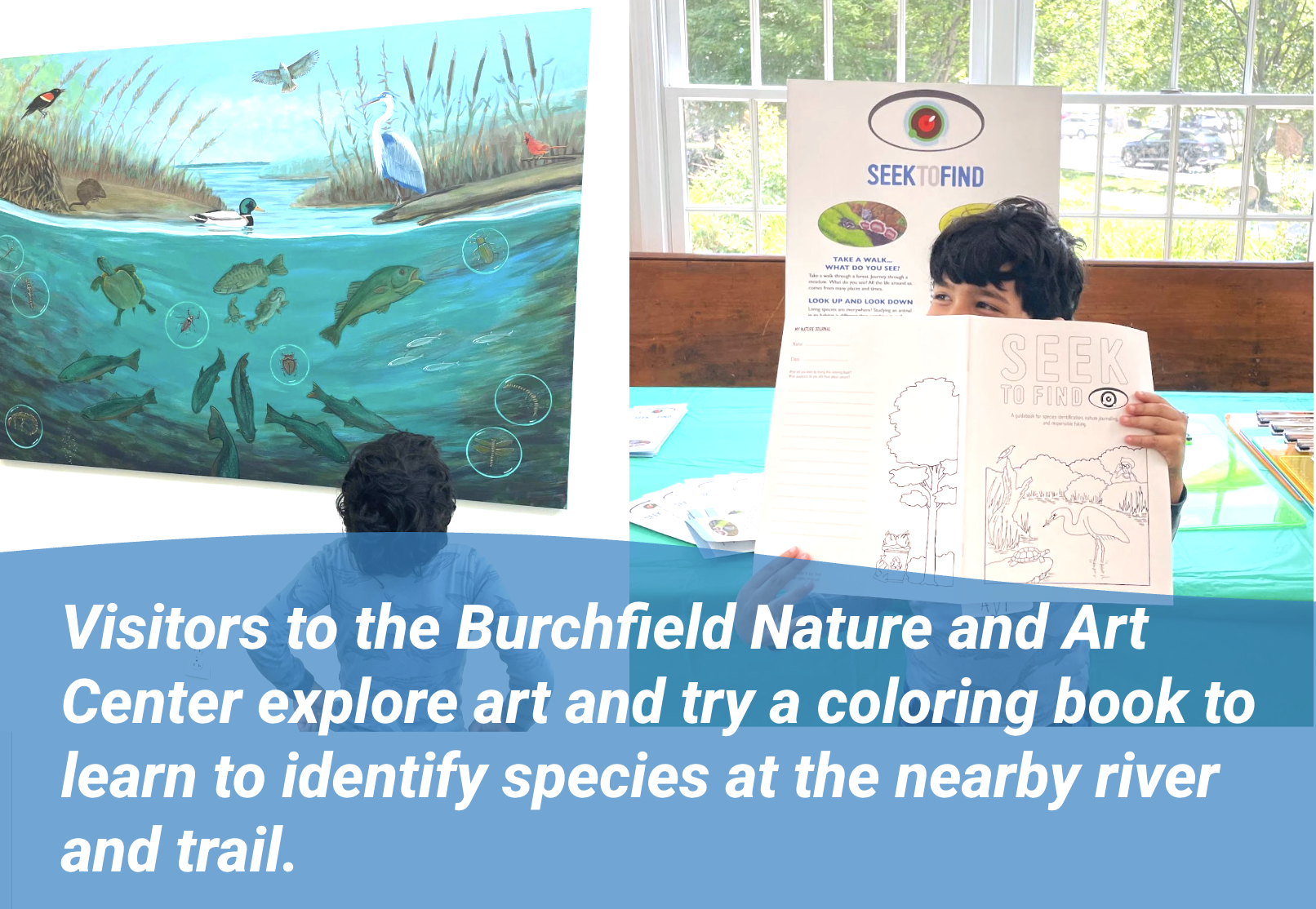
Visitors to the Charles E. Burchfield Nature and Art Center explore art and try out a coloring book to learn to identify and draw species at the nearby river and trail. (West Seneca, NY)
Then, we use Seek to ID the specimen…and our own drawings! Can we study the specimen closely enough to make a drawing that Seek can recognize? How does AI compare the features of an image to categorize a species? Using art and tech together, youth learn principles of biology, and the patience to observe closely and draw. Then, uniting their drawings and the species names they’ve identified, we create collages for model-based inquiry, showing how species interact in the natural environment.
Building from these lesson plans, I created a coloring book that brings this process to more youth ecologists. Now, teachers in Canada’s Eco-club school programs are using the coloring book, the Seek app, and guiding questions together to make studies of the species habitats in their school yards and neighborhoods.
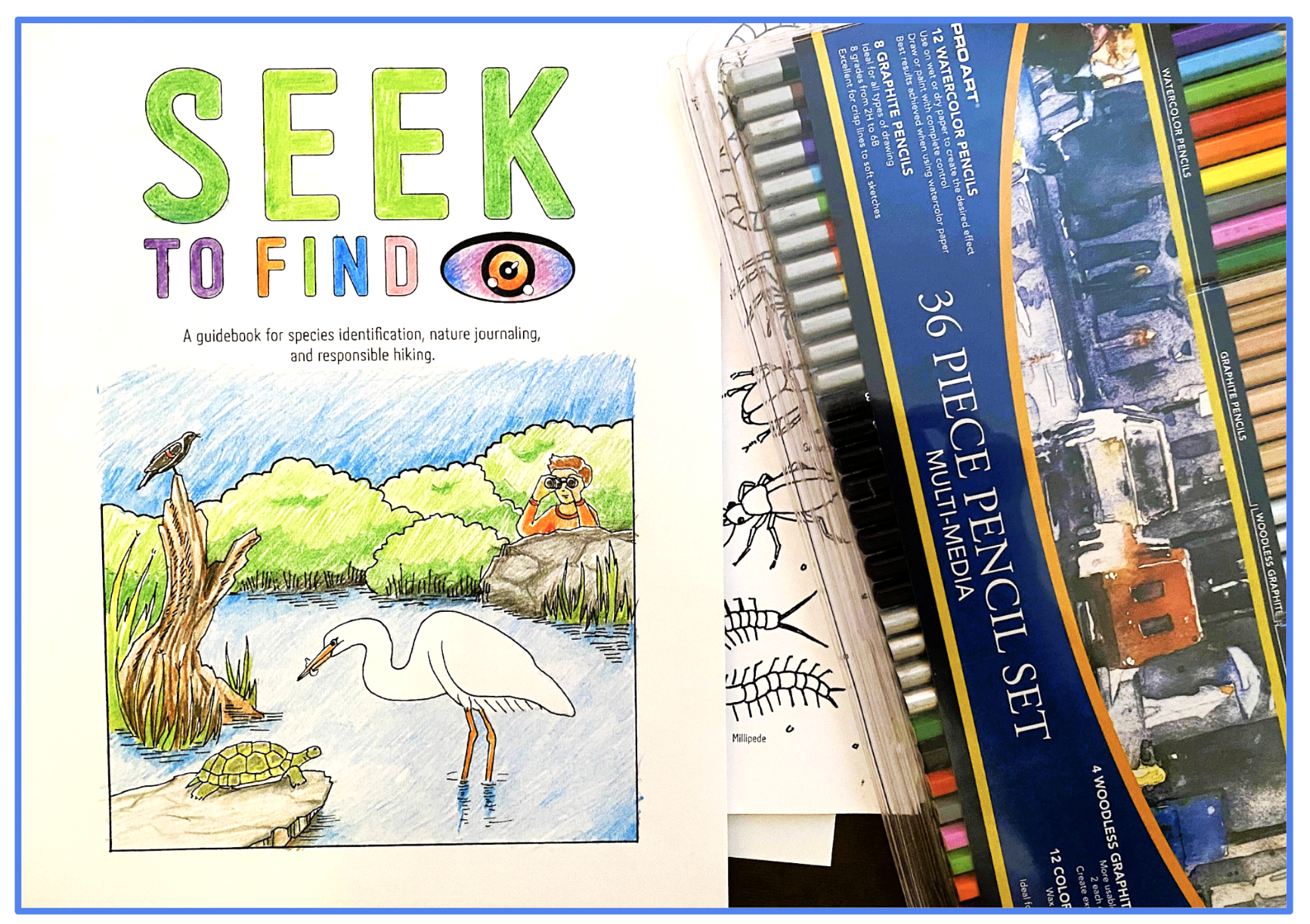
Seek to Find coloring book
Debts or Skills? Charting Skill Development Pathways for AI Learning Futures
Recent research on AI for Education reminds us of an important challenge for instructional design and the development of new curriculum. We have to chart out the pathways that are part of learning the skills of a discipline…and when we use AI tools, we need to use them in a way that supports real cognitive skills.
A study of essay writers who used AI (compared to those who didn’t) showed key differences in brain activity. When we don’t practice the skills ourselves, we don’t develop the neural connections we need to complete the task, a finding which the researchers call “cognitive debt” (Kosmyna et al, 2025).
The applications of Artificial Intelligence in Education (AIED) are rapidly evolving, reshaping the overall teaching and learning landscape…Research on AIED has surged in recent years…exploring various aspects of these applications, including design, effectiveness, and outcomes. – Wang et al, 2024
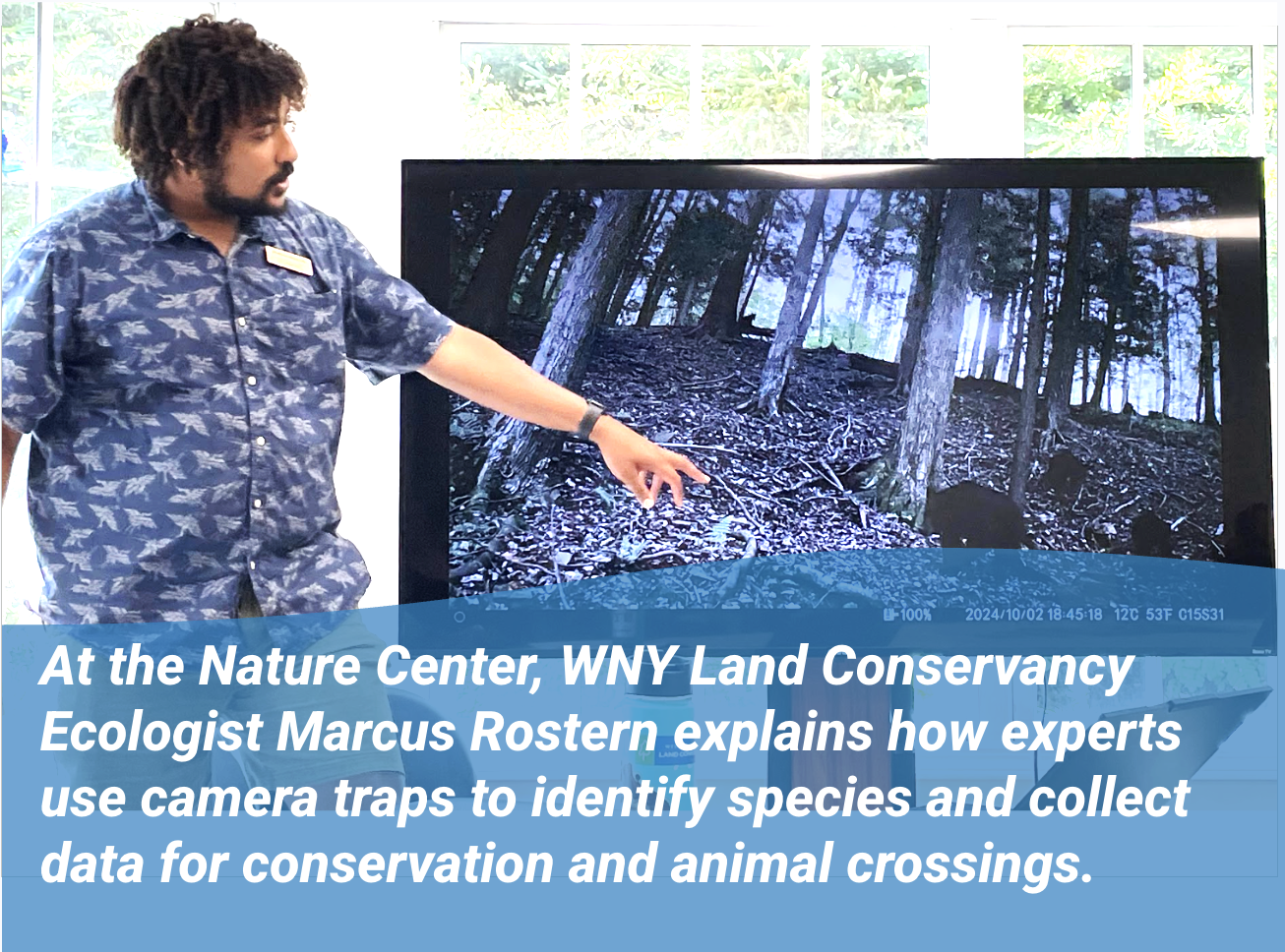
At the Nature Center, WNY Land Conservancy ecologist explains how experts use camera traps to identify species and collect data for conservation and animal crossings.
My experiences with teaching Seek, naturalist drawing, and ecology education together has provided some new ideas about how AI can be leveraged for learning…without supplanting the skills that connect learners to a discipline.
Drawing on the study of cognition and skills, I propose that teachers develop a clearer lens to look at how cognitive pathways develop through participation in complex activities. We can define three types of experiences with AI tools for learning skills:
Enskillment: The development of embodied, cognitive skills through mentorship during complex activities that combine tools and tasks (from Ingold, 2000).
Deskillment: The loss (or failure to develop) a skill set because it is externalized through a technological “helper,” such as writers using a Large Language Model, instead of their own research (as in “cognitive debt”, Kosmyna et al, 2025)
Reskillment: The intentional practice of skillsets without technological tools in order to foster the skill, and connected cognitive development. For example, navigating a city with and without the use of a digital map to bring attention to landmarks, street names and spatial relationships. Using the tech– and putting it down– in cycles can serve as a retrieval practice.
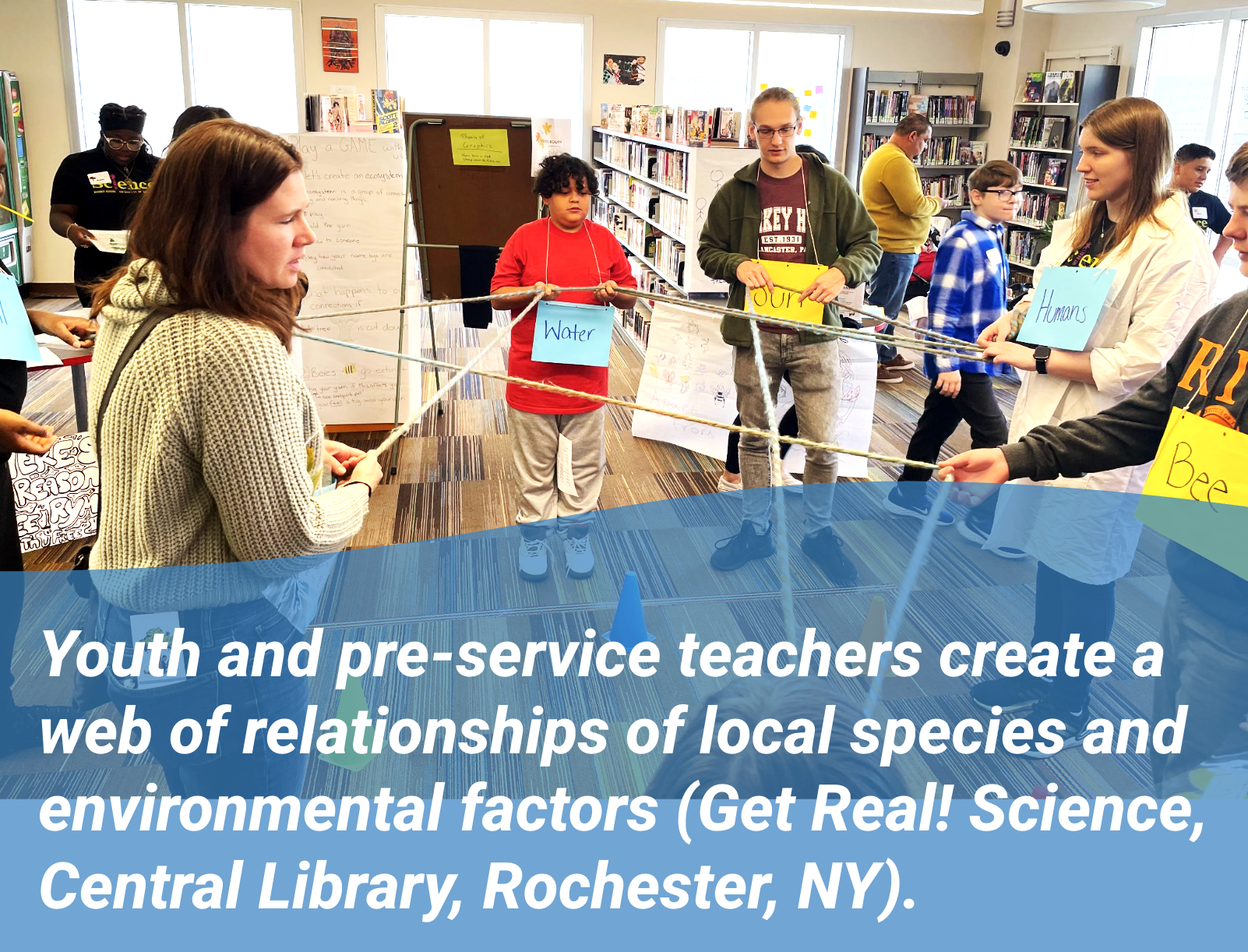
Youth and pre-service teachers create a web of relationships of local species and environmental factors (Get Real! Science, Central Library, Rochester, NY).
Design Principles for Skill Development and AI for Education
Thinking about this process, I offer four useful strategies for thinking about how students will gain real skills–without replacing their real learning with technology dependence. Try these strategies as you consider how to including AI tools in unit plans…
Create a skills inventory list: Embodied skills, language skills, teamwork skills, visual skills, and data analysis skills…There are many types of cognitive development taking place when we do science. To prepare for a lesson, make a list of skills that researchers use in the field. Consider how an AI tool might be a teamwork helper…without taking over the skill development trajectory. Create “replica” projects that introduce some key aspects of the skill…Practice with and without AI assistance.
Create a Design Conjecture Map: A conjecture is an idea about what is happening in the learning environment. What would you like to see happening in the classroom? How do you know– through observations– that students are developing and practicing a new skill? Chart out the learning paths in terms of materials and interactions. (From Sandoval, 2014)
Draw a Task Map and a Storyline Storyboards:: Skill acquisition happens in a taskspace. Draw a map of the learning environment. Does it have tables with various projects? Will the learning connect to students’ home, family, or community environment? Consider how skill development will happen through a sequence of connected experiences. Use stick figures and doodles to chart out the materials and embodied experiences learners will engage in.
Can I explain the tech? Don’t treat the AI tool as something more intelligent than you and your students working together! AI tools build from routines that humans already know how to do…such as comparing many images of related species. Learn about the operations that the technology tool is doing, and discuss these underlying processes with the learners. Remember, just like people, AI tools can make mistakes!
Quick Assessments and Retrieval Practice: Build low-tech retrieval practice into the unit. Create short, engaging ways that students’ can demonstrate learning. Allow students to draw on what they’ve learned to answer questions and solve new challenges.
Citations & Links:
Ingold, T. (2000). The Perception of the Environment: Essays on Livelihood, Dwelling and Skill. Psychology Press.
Kosmyna, N., Hauptmann, E., Yuan, Y. T., Situ, J., Liao, X.-H., Beresnitzky, A. V., Braunstein, I., & Maes, P. (2025). Your Brain on ChatGPT: Accumulation of Cognitive Debt when Using an AI Assistant for Essay Writing Task (arXiv:2506.08872). arXiv. https://doi.org/10.48550/arXiv.2506.08872
Sandoval, W. (2014). Conjecture Mapping: An Approach to Systematic Educational Design Research. Journal of the Learning Sciences, 23(1), 18–36. https://doi.org/10.1080/10508406.2013.778204
Wang, S., Wang, F., Zhu, Z., Wang, J., Tran, T., & Du, Z. (2024). Artificial intelligence in education: A systematic literature review. Expert Systems with Applications, 252, 124167. https://doi.org/10.1016/j.eswa.2024.124167